
quantlab-factor-agent#
Version 0.2.0
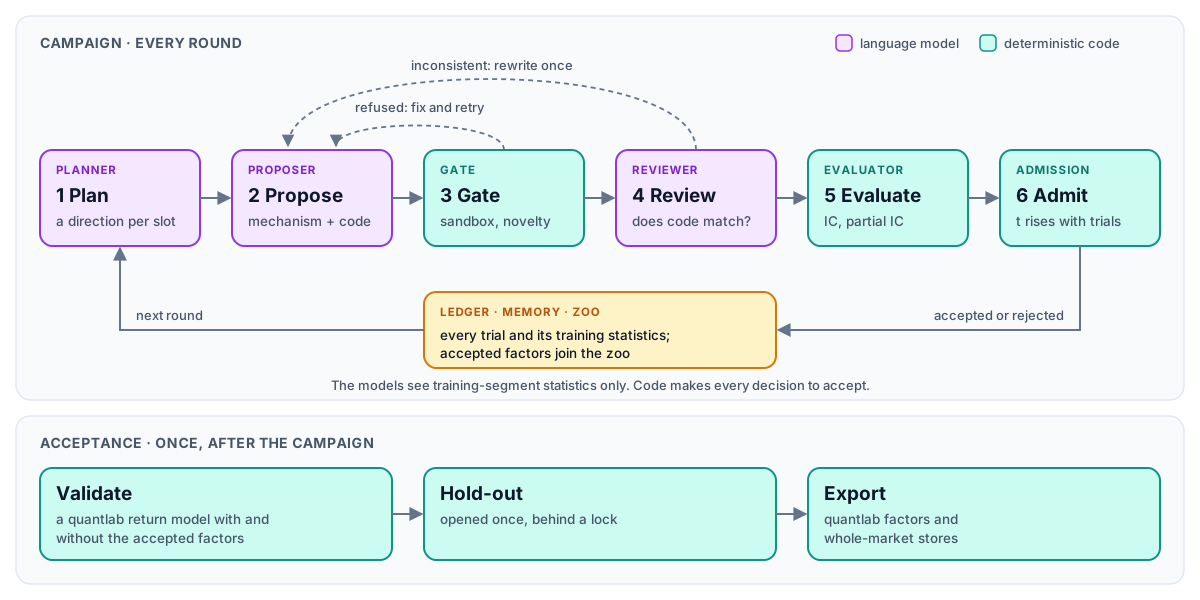
quantlab-factor-agent mines daily stock factors with language models. A model states an economic mechanism, writes the factor it implies as KunQuant code, and a fixed pipeline decides whether the factor is new and adds to the factors you already have. The language model only proposes and reviews; every decision to accept is made by deterministic checks and statistics computed by quantlab on the training segment, which is all the model is ever shown.
Install the package next to quantlab and run a first campaign from a config file.
The research loop, the campaign config, the vocabulary, the prompts, the LLM backends, evaluation and acceptance.
Classes and functions: Campaign, CampaignConfig, Gate, Evaluator, Acceptance
and the LLM backends.
The terms the rest of the documentation uses: roles, mechanism types, the reference set, known factors, proposal groups, segments and what “accepted” means.
What a campaign does#
            +-----------+   directions   +-----------+   candidates   +--------+
 ledger --> |  planner  | -------------> |  proposer | -------------> |  Gate  | -- refused: fix and retry
 memory     +-----------+                +-----------+                +--------+
                                                                          |
                    accepted <-- admission <-- Evaluator <-- reviewer <---+
                       |                       (training     (hypothesis,
                       +--> zoo, pool, ledger    segment)     code agree?)
Step |
Who |
Decides |
|---|---|---|
Plan |
planner (LLM) |
one research direction per slot: a new mechanism, or a mutation or a refinement of an earlier trial |
Propose |
proposer (LLM) |
a hypothesis, a description and KunQuant code for each direction |
Gate |
code |
the code builds in a sandbox, reads only the vocabulary, is not a rewrite of an existing factor |
Review |
reviewer (LLM) |
the hypothesis, description and code describe the same factor |
Evaluate |
code |
IC, partial IC, correlations, deciles and coverage on the training segment |
Admit |
code |
the factor clears the correlation, partial-IC t, monotonicity and coverage thresholds |
After a campaign, acceptance trains a quantlab return model with and without the accepted factors on the validation segment, opens the hold-out once, and exports the chosen factors as quantlab factors and whole-market stores.