
How the agent mines factors#
The agent searches for factors the way a research team would: it proposes an economic mechanism, writes the factor the mechanism implies, and keeps it only if the factor is new and adds to what is already known. Language models do the proposing and one consistency check. Everything that decides whether a factor is kept is deterministic code working on statistics the models cannot influence. This page explains the mechanism without the config keys; concepts and the pages it links give the details.
1. The search: mechanisms, not formulas#
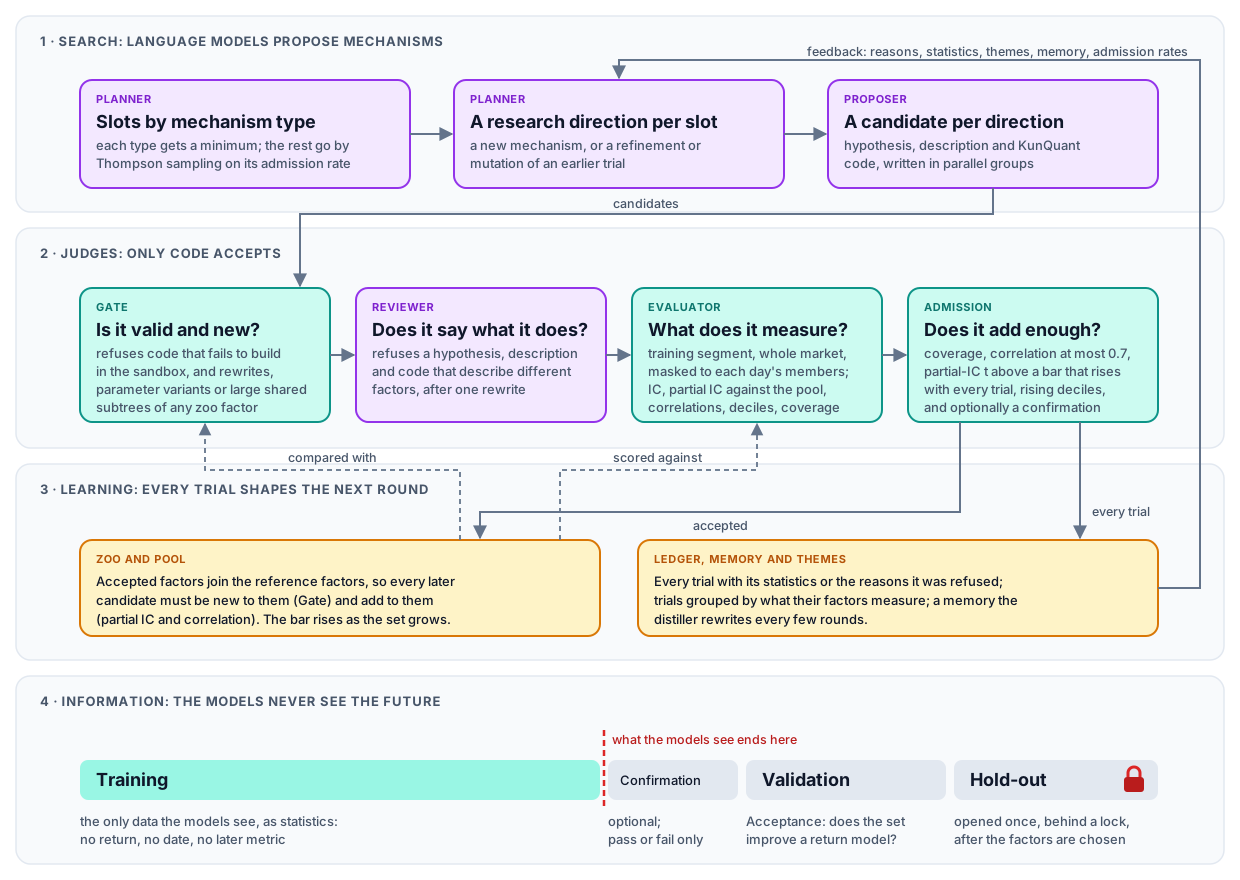
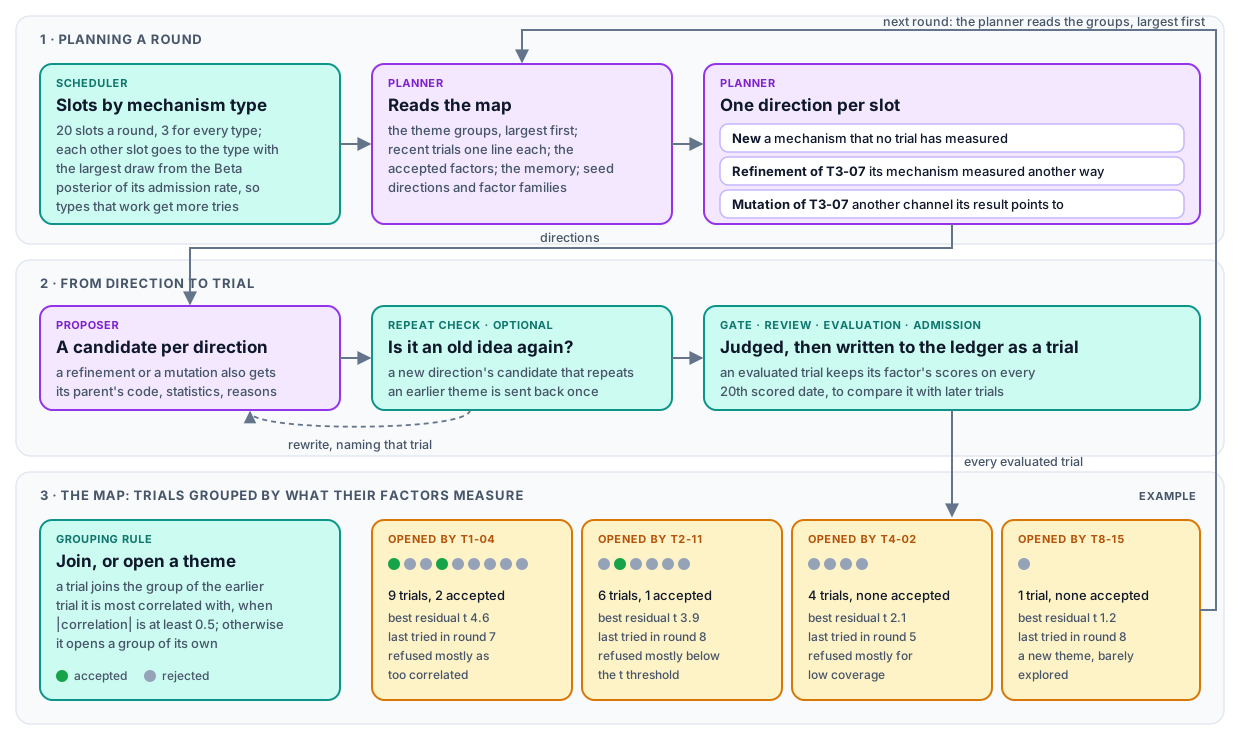
A campaign runs in rounds of a fixed number of slots, twenty by default. Each slot belongs to a mechanism type, a broad reason why some stocks earn more than others over the next few days: behavioural biases, risk compensation, liquidity, market microstructure and the slow diffusion of information. Every type gets a few slots each round, so no type is abandoned early. The remaining slots go to the types that have been admitted most often so far, by Thompson sampling: a type that keeps producing factors gets more attempts, and a type that has done badly still gets some.
The planner writes one research direction per slot. A direction is either a new
mechanism, or builds on an earlier trial, named by its id (T3-07 is round 3’s seventh
slot):
a refinement measures the parent’s mechanism in another way, to remove what got it refused or to strengthen an accepted factor;
a mutation follows a different channel that the parent’s result points to.
The proposer turns each direction into a candidate: a hypothesis (why the mechanism should predict returns), a description of the factor, and KunQuant code that computes it from the fields the vocabulary opens. A round’s directions are split into proposal groups that are written in parallel, each by calls of its own.
The models are never asked to search over formulas. They are asked for mechanisms, the Gate refuses what is merely a variant of an existing factor, and the reviewer checks that the code measures what the mechanism says.
2. The judges: only code accepts#
Every candidate passes four judges in turn. Each can refuse it, and the first refusal is the recorded reason.
The Gate checks the code before any data is read. The code may use only the vocabulary’s fields and operators; it must build its factor graph in a sandboxed process within a time and memory limit; its graph must stay within limits on size, hand-set constants and the number of input fields. The Gate then compares the graph with every factor in the zoo (the reference factors, other known factors and the factors accepted so far) after putting both in a canonical form. A rewrite of an existing factor, the same graph with other parameters, or a large shared subtree is refused, and the refusal names the factor. A refused candidate goes back to the proposer with the reasons and may be fixed twice.
The reviewer, a language model, reads the hypothesis, the description and the code together and judges whether they describe the same factor. One that does not is sent back once to be rewritten; a candidate still inconsistent is rejected without being evaluated.
The Evaluator is the only part that reads market data. It computes every surviving candidate on the whole market over the training segment, scores it on each day’s members of the universe, and measures its rank IC, its partial IC (the IC of what is left after regressing the candidate on every factor in the pool), its correlation with each existing factor, its decile returns and its coverage.
Admission accepts a candidate only when, in this order:
it has a value for at least half the members on an average day;
its training IC is nonzero, which gives it a direction (a negative IC means the factor is used as its negative);
it is correlated at most 0.7 with every reference, accepted and known factor;
its partial IC is significant: its Newey-West t clears a threshold that rises with the number of trials evaluated so far;
its decile returns rise with the decile.
3. Learning: every trial shapes the next round#
Every slot ends as a trial in the ledger, accepted, rejected or failed, with its statistics or the reasons it was refused. The next round’s planner and proposer read:
the last round’s statistics and rejection reasons, and a one-line summary of each trial of the last few rounds;
the accepted factors, each with its weight and residual IC in the accepted set;
for a candidate refused for low coverage, the step of its graph where the values were lost;
a memory, a short text the distiller model rewrites every few rounds from the trials since the last one, about what worked and what did not;
optionally, themes: the evaluated trials grouped by what their factors measure, each group with how often it was tried and accepted, so the planner can see which ideas are exhausted. A new direction whose candidate repeats an earlier group can be sent back once to be rewritten before it is evaluated;
optionally, each trial’s Lineage: how many trials built on it, refinements and mutations, how many stopped before evaluation, which were accepted, and the best child’s residual t against its own, on the accepted factors the planner reads and on the parent a refinement or a mutation is written from, so the planner can tell a lineage that keeps giving from one that is exhausted.
optionally, Picked parents: some slots’ parents chosen by the code instead of the planner, the evaluated trials first by Pareto rank of their quality, their fertility (how their children did) and their distance from the accepted factors, each shared with the trials related to them by lineage, structure and correlation; the planner still writes each picked slot’s action and idea.
An accepted factor also changes what later candidates are judged against. It joins the zoo, so the Gate refuses its rewrites, and it joins the pool, so the next candidate’s partial IC is what it adds beyond it. Within a round, candidates are admitted in order and each accepted one joins the pool before the next is judged, so two near-copies of one idea cannot both pass. The bar rises as the set grows.
With themes turned on, the themes and the choice of directions form a map of what the search has tried:
4. Information: the models never see the future#
The data is split into segments in time: training, then validation, then a hold-out. The models see only statistics of the training segment. No prompt carries a return, a date or any validation or hold-out number, and papers in seed directions are cited without their year. The last bars of each segment, whose label would read into the next, are dropped.
The validation segment is used only after the campaign, to judge the accepted factors together. The hold-out is opened once, behind a lock, after the factors have been chosen on validation; a second opening is refused unless forced, and the report then says so.
Guarding against luck#
A search that tries hundreds of factors will find some that look good by chance. The agent guards against that in four layers:
A threshold that counts the trials. The partial-IC t needed for admission is a Bonferroni correction over every evaluated trial, each counted twice because the direction is read from the data: about 3.2 for the first trial, 3.8 at 10, 4.4 at 100 and 4.7 at 600.
A confirmation segment. The trial count cannot account for a search that adapts to its own feedback. In a test on daily bars, a run that read its trials accepted more factors than a run that read none, without a larger sum of validation partial t. Optionally, the later part of the training data is set aside as a confirmation segment. A candidate that passes everything else must also hold there, and the models are told only that it failed, never by how much.
Validation of the set. After the campaign, a quantlab return model is trained with and without the accepted factors, and predicts the validation segment. The report can also measure each factor alone, by dropping it from the set or adding only it to the baseline. There is no threshold here: you choose which factors to keep.
A hold-out opened once. The chosen selection is measured on the hold-out a single time.
A control run with feedback turned off, in which every direction is new, shows how much the learning loop adds over undirected proposals.
After the campaign#
The chosen factors are exported as quantlab factors and whole-market stores, each turned to its direction so that a higher value always means a higher expected return. See acceptance.
A campaign stops after a set number of rounds or trials, after several rounds in a row without an acceptance, or when the model provider refuses a call for an exhausted balance or quota. It can be resumed from its run directory at any point.